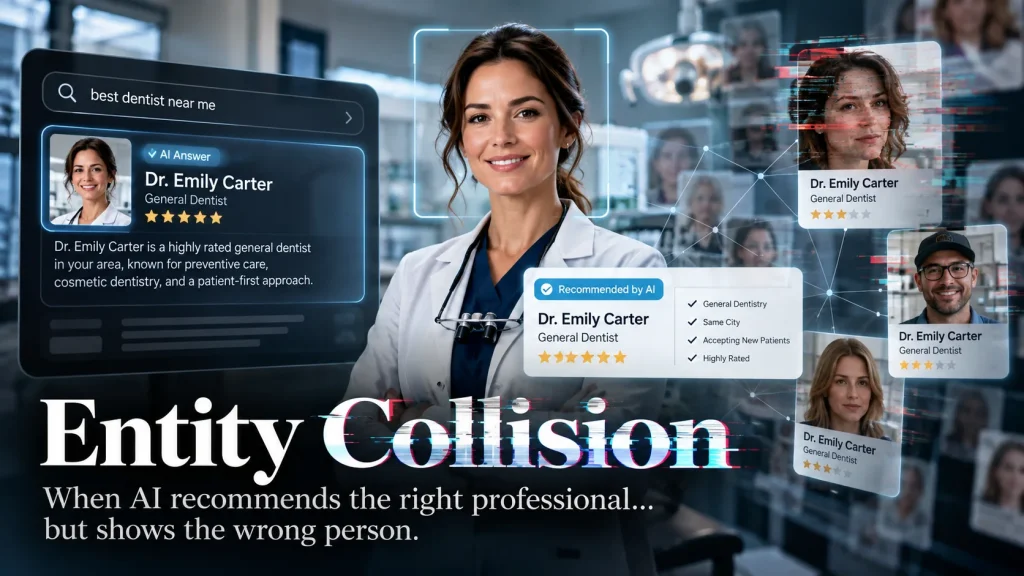
Why entity disambiguation may become one of the most important issues in AI search visibility
For more than two decades, businesses have worried about whether Google could find them.
Then the question became whether Google could rank them.
Now an entirely different question is emerging:
Can artificial intelligence correctly understand who you are?
That sounds simple.
It is not.
During a series of AI search visibility tests conducted by SytecAI, we encountered two examples involving professionals in completely different industries, dentistry and law, that exposed a potentially serious weakness in the way AI-generated search experiences assemble information about people.
In both cases, the artificial intelligence appeared capable of identifying a highly relevant professional.
But something went wrong when the system attempted to connect that professional with a visual or clickable identity.
In one case, the recommended dentist was correct, while the attached professional identity was associated with someone else.
In another, the same attorney repeatedly appeared as the leading recommendation, and his website remained correct, but the thumbnail image associated with him changed between repeated searches.
The underlying technical cause cannot be conclusively determined from outside the AI platform.
But the visible problem can.
We call the practical result entity collision.
And as AI increasingly becomes the place where consumers decide whom to call, hire, visit, or trust, entity collision may become an important new concern for businesses, professionals, reputation managers, SEO firms, and AI visibility specialists.
The danger is easy to understand.
A professional can be recommended correctly,
while being represented incorrectly.
And when that happens, traditional concepts of ranking and visibility are no longer enough.
Search Engines Find Pages. AI Systems Try to Understand Entities.
Traditional search was largely document-oriented.
A search engine crawled pages, evaluated relevance and authority, and presented links.
If someone searched for:
“best implant dentist Spring Lake Michigan”
the primary question was historically:
Which web pages deserve to rank?
AI search changes the problem.
An AI system may attempt to construct an answer.
That answer can combine information from multiple places:
- the professional’s website,
- business profiles,
- directories,
- news articles,
- review platforms,
- structured data,
- professional associations,
- images,
- knowledge databases,
- and other sources.
Instead of simply retrieving a page, the system is often trying to determine:
Who is this person?
That makes the concept of an entity extremely important.
An entity is a specific thing that should be distinguishable from other things.
A person is an entity.
A company is an entity.
A law firm is an entity.
A dental practice is an entity.
A location is an entity.
An organization is an entity.
“Jared Van Ittersum, DDS, the dentist practicing in Spring Lake, Michigan” should therefore be understood as one distinct entity.
“Niles S. Illich, Ph.D., J.D., the Texas appellate attorney” should be understood as another.
The challenge for an AI system is not simply recognizing their names.
The system must correctly associate each name with the appropriate occupation, organization, location, photograph, credentials, website, biography, phone number, reviews, and other identifying attributes.
That process is commonly described using terms such as entity resolution and entity disambiguation.
Entity resolution attempts to determine whether different records refer to the same real-world entity.
Entity disambiguation attempts to determine which person or organization is intended when names or characteristics could refer to more than one candidate.
These are not trivial problems.
And the emergence of generative AI is making their accuracy increasingly visible to ordinary consumers.
What We Mean by “Entity Collision”
We use entity collision as a practical term for what the user experiences when information belonging to distinct people or organizations becomes incorrectly associated.
It should not be confused with a claim that an AI provider’s internal knowledge graph has literally merged two records.
We cannot see the internal process.
The failure might happen during retrieval.
It might happen during entity matching.
It might occur during image selection.
It might occur when an interface creates a clickable professional card.
It might even occur after the answer itself has already been generated.
The technical mechanism can differ.
The consumer-facing result is what matters.
A person searches for Professional A.
The AI correctly writes about Professional A.
But a photograph, card, profile, credential, business address, or other identifying element belongs to Professional B.
From the consumer’s perspective, the identities have collided.
That distinction is crucial.
AI visibility without identity integrity is incomplete visibility.
Case Study One: The Correct Implant Dentist, With the Wrong Identity Attached
Our first discovery happened during what began as a simple test.
The query was:
“best implant dentist spring lake mi”
ChatGPT returned Dr. Jared Van Ittersum as the first recommendation.
That part of the result made sense.
Infinity Dental’s own website identifies Dr. Jared Van Ittersum as a Spring Lake dentist and specifically references surgical implant placement among his areas of practice. The practice also identifies Spring Lake as his local market. infinitydentalspringlake.com
The textual recommendation therefore aligned with identifiable information available online.
But then we clicked the professional identity attached to Jared’s name.
And the result changed.
Instead of opening or displaying information corresponding cleanly to Dr. Jared Van Ittersum, the professional card displayed:
“Jaron Vanmeter, DDS.”
The result was no longer merely about Jared.
A different dentist identity had entered the presentation.
That is the important part of the case.
The query had found the intended dentist.
The written answer had identified the intended dentist.
But the identity interface associated with that answer did not remain reliably attached to the same person.
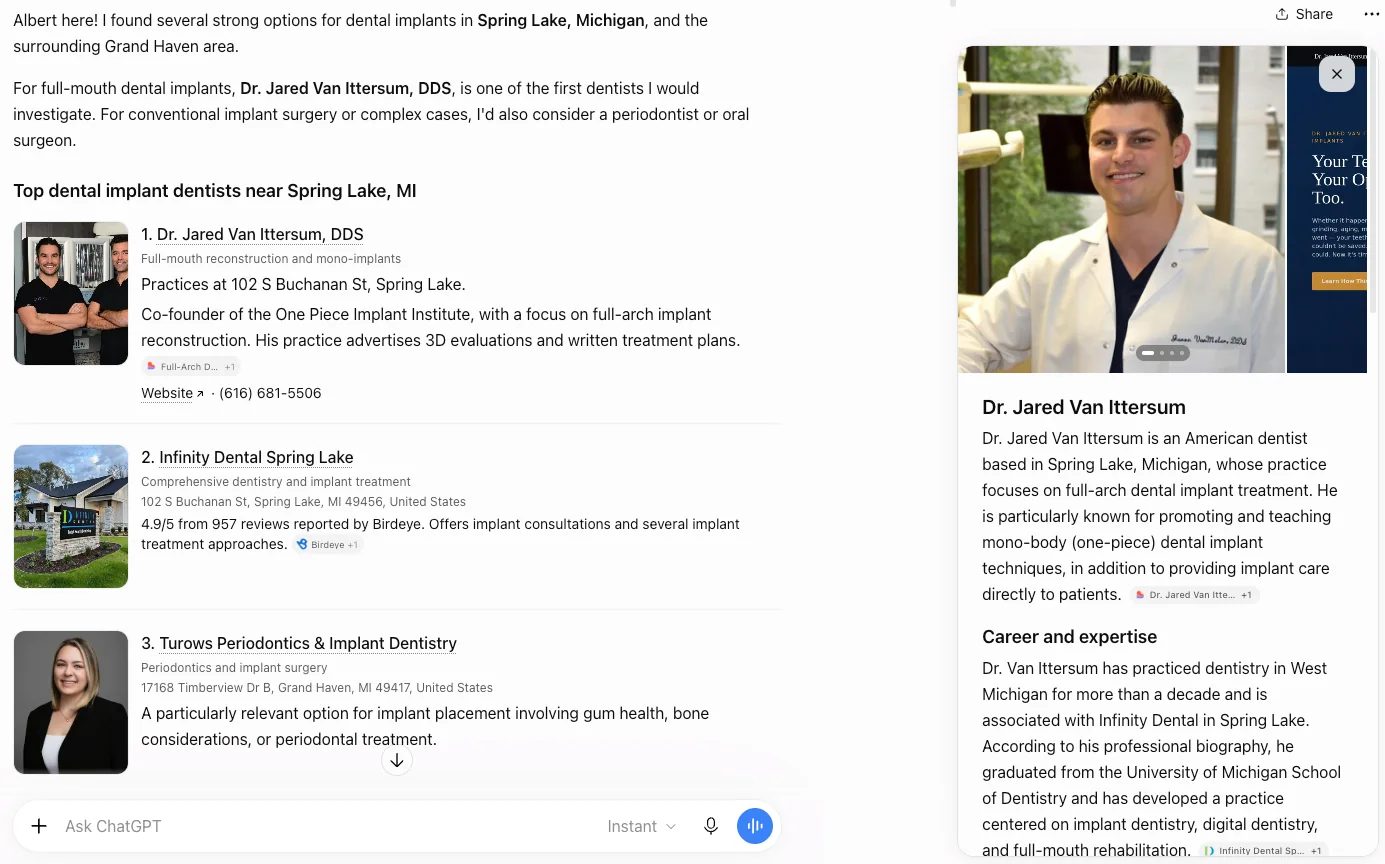
This is precisely why merely checking the wording of an AI answer is no longer sufficient.
The recommendation itself was not the entire user experience.
The user could click deeper.
And after clicking deeper, the identity changed.
Why This Case Is More Significant Than a Typographical Error
At first glance, it would be easy to dismiss this as a spelling problem.
It is not.
A misspelled name would look something like:
Jared Van Ittersum
becoming:
Jarred Van Ittersum.
That would be a data-quality error.
What happened here is fundamentally different.
The AI experience went from one professional to another professional.
That is an identity-association problem.
Consider the implications.
A prospective implant patient might read about a dentist, become interested, click the name to learn more, and then be presented with another dentist’s professional identity.
The AI has not simply misspelled someone’s name.
It has potentially interrupted the trust chain between:
recommendation → professional → identity → action.
That chain matters because AI search is increasingly moving closer to the point of decision.
Users are not always conducting academic research.
They may be choosing a dentist.
Choosing an attorney.
Choosing a physician.
Choosing a financial adviser.
Choosing a contractor.
Choosing someone to care for their child.
Choosing someone to represent them in court.
In those situations, identity accuracy is not cosmetic.
It is fundamental.
Case Study Two: The Attorney Who Stayed Number One While His Picture Changed
Our second case appeared in an entirely different professional category.
The query was:
“best criminal appellate attorney Texas”
Across two separate tests conducted by the client and SytecAI, the same attorney appeared as the leading recommendation:
Niles S. Illich.
That consistency itself is noteworthy.
Niles’s official law firm website describes him as a Texas appellate attorney and states that he is board certified in criminal appellate law. His Justia profile similarly identifies him in Appeals & Appellate and Criminal Law and lists his Texas Bar identification. Appellate Lawyers Dallas Texas
The website link appearing with the ChatGPT result was also correct.
So several parts of the identity chain remained intact:
Name: correct.
Professional category: correct.
Website: correct.
Recommendation: consistent across the observed tests.
But one element did not remain consistent.
The thumbnail image.
Each time the search was run, a different thumbnail appeared.
That creates a particularly interesting form of entity uncertainty because the underlying textual entity appears stable while the visual representation appears unstable.
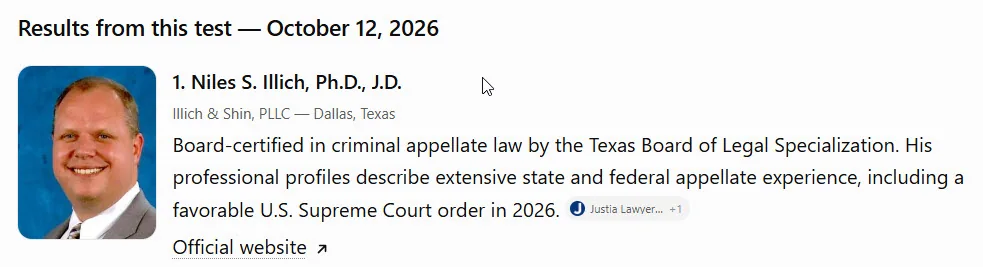
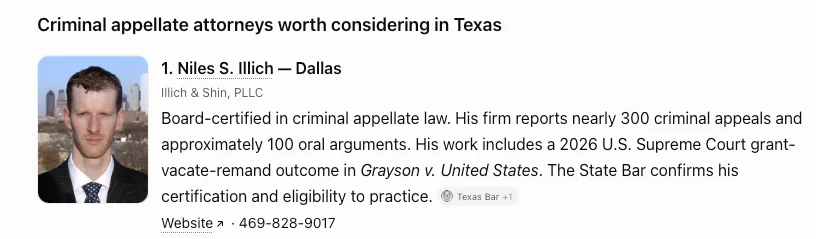
Here is his actual photograph:

Changing Images Do Not Automatically Prove Misidentification
This distinction is important.
A professional may legitimately have multiple photographs.
Someone could have:
- a formal headshot,
- an older headshot,
- a law-firm photograph,
- a conference photograph,
- a directory photograph,
- a media photograph,
- and a social profile image.
Therefore, two different images does not automatically mean the AI displayed two different people.
That must be verified.
But even before verification, repeatedly changing identity imagery tells us something useful:
the image association may not be stable.
And if investigation shows that one or more of those photographs depicts another individual, then the issue becomes materially more serious.
It becomes a visual entity attribution failure.
That is why SytecAI believes an emerging discipline of AI search auditing must evaluate much more than whether a client’s name appears.
The New Question: Does AI Know Exactly Who You Are?
For years, SEO professionals asked:
Does Google know what this page is about?
Local SEO added:
Does Google know where this business is?
Schema specialists asked:
Can search engines understand the relationships among the information on this page?
AI search introduces another question:
Can the AI confidently distinguish this person from every other similar person?
That is a disambiguation problem.
Imagine two attorneys.
Both are named Michael Anderson.
Both practice criminal law.
Both practice in Texas.
One is in Dallas.
One is in Houston.
Now add attorney directories, news articles, LinkedIn profiles, law-firm pages, reviews, duplicate directories, outdated biographies, old practice locations, social profiles, image-search results, and scraped databases.
An AI system must decide which pieces of information belong together.
Names alone are not enough.
Profession alone is not enough.
Geography alone may not be enough.
The more characteristics two entities share, the more evidence may be needed to separate them.
This is the essence of disambiguation.
Structured Data Already Recognizes the Problem
Interestingly, the web’s structured-data vocabulary already contains mechanisms intended to improve identity clarity.
Schema.org’s Person vocabulary supports properties including:
nameimageidentifieraffiliationurlmainEntityOfPagesameAs- and
disambiguatingDescription. Schema.org
The existence of disambiguatingDescription is particularly relevant.
Schema.org describes it as a short description used to distinguish an item from other similar items. Schema.org
The sameAs property serves another important purpose: it can point to a page that unambiguously indicates the entity’s identity. Schema.org
Those are powerful concepts.
But they need to be implemented thoughtfully.
Adding schema does not create truth.
Schema communicates information.
If incorrect profiles are connected through sameAs, the website may actually reinforce confusion.
If multiple professionals share images incorrectly, structured markup may reinforce confusion.
If an outdated page describes someone at the wrong organization, that inconsistency becomes another data point AI systems may encounter.
The objective is therefore not simply:
“Add schema.”
The objective is:
Create an unambiguous digital identity and reinforce it consistently.
The Professional Identity Graph
At SytecAI, we believe businesses should begin thinking about a professional’s online presence as an identity graph.
Imagine the professional at the center.
Connected to that person are:
- their official biography,
- business website,
- professional license,
- business profile,
- directory listings,
- social profiles,
- author pages,
- news coverage,
- professional associations,
- videos,
- photographs,
- publications,
- structured data,
- reviews,
- and organizational affiliations.
Ideally, every important node points back toward the same real-world human being.
The stronger and more consistent that graph becomes, the easier it should be for information systems to distinguish that person from others.
Problems appear when those connections conflict.
One directory uses a middle initial and another does not.
An old office remains online.
A former partnership still lists the individual.
Two different photographs use the same filename.
An attorney changes firms but hundreds of pages remain indexed.
A doctor’s professional name differs across insurance directories.
A biography is copied incorrectly.
A profile uses a relative’s photograph.
A third-party directory mixes two similar names.
None of these alone guarantees an AI error.
But collectively, ambiguity increases.
How Professionals Can Reduce the Risk of Entity Collision
No business can guarantee that an external AI platform will never make an identification mistake.
The platform controls its own retrieval, ranking, generation, image selection, and user interface.
What businesses can do is make their identities dramatically easier to resolve.
SytecAI recommends treating identity integrity as an ongoing digital asset rather than a one-time SEO task.
A practical identity-assurance program should include the following:
- Create one authoritative person page. Every important professional should have a dedicated page whose primary subject is that individual. It should clearly state the professional’s full name, credentials, occupation, organization, location, areas of expertise, and other distinguishing information.
- Give the person a persistent structured-data identity. The page should use appropriate Person markup with a stable
@id, rather than generating different representations of the same person across pages. - Use
disambiguatingDescriptiondeliberately. Do not fill it with promotional copy. Use it to distinguish the individual. For example: “Niles S. Illich, Ph.D., J.D., a Dallas attorney board certified in criminal appellate law in Texas.” - Connect only verified
sameAsidentities. Every profile included should unquestionably belong to the same individual. More links are not necessarily better. Correct links are better. - Use authoritative professional identifiers when appropriate. Lawyers may have state bar identifiers. Physicians and dentists may have NPIs. Other regulated professions may have licensing identifiers. These can help distinguish one professional from another.
- Standardize professional imagery. Maintain a canonical headshot and make it easily identifiable on the official biography page. Different photographs are acceptable, but they should all clearly and consistently belong to the same professional.
- Audit major third-party profiles. Check industry directories, associations, rating platforms, professional databases, social platforms, and business listings for contradictory names, images, addresses, credentials, or affiliations.
- Remove or correct stale identity signals where possible. Old firms, former office locations, abandoned websites, and obsolete biographies may continue to influence how a professional is understood online.
- Test AI platforms directly. Do not merely search for the client’s name. Search the way a prospective customer would: “best implant dentist near me,” “best criminal appellate attorney Texas,” “best estate planning lawyer Dallas,” and similar decision-stage questions. Inspect names, photographs, links, citations, descriptions, affiliations, and profile cards.
- Document errors and retest them. Capture the query, date, platform, screenshot, incorrect element, correct source, and outcome. Entity problems should be monitored over time in the same way rankings and conversion problems have historically been monitored.
Schema Is Important, But Schema Alone Is Not the Solution
There will be a temptation in the SEO industry to turn this into another checkbox.
“Add Person schema and the problem is solved.”
We do not believe that is responsible.
Schema is one signal.
The AI environment is broader than one website.
Consider Niles Illich.
His official firm website clearly identifies him and describes his appellate practice. Appellate Lawyers Dallas Texas
His Justia profile independently identifies him and includes professional details. Justia Lawyer Directory
Yet our tests still raised questions about the image selected by an AI interface.
That tells us something important.
Correct source data does not guarantee correct presentation.
The AI platform still performs its own selection and assembly.
The objective therefore becomes twofold:
Strengthen the source identity.
And:
Audit the final AI representation.
That second step is becoming increasingly important.
AI Search Visibility Needs a New Metric: Identity Integrity
Most AI visibility tools currently focus on questions such as:
- Did the brand appear?
- How often was it mentioned?
- Was it recommended?
- What position did it appear in?
- Which sources were cited?
Those are valuable measurements.
But they may miss an important failure.
Imagine this result:
Your law firm is recommended first.
Your attorney’s name is correct.
Your description is excellent.
Your website is linked correctly.
But the photograph belongs to someone else.
Should that count as a successful AI visibility result?
We would argue that it should not.
Visibility needs an accompanying measure:
Identity Integrity.
An Identity Integrity audit would ask:
- Is this the correct person?
- Is this the correct organization?
- Is the image correctly attributed?
- Does the professional card represent the same person discussed in the answer?
- Is the website correct?
- Are the credentials correct?
- Is the location correct?
- Are professional affiliations current?
- Do linked identities actually belong to this person?
- Does AI remain consistent when the query is repeated?
This represents a different mindset.
The goal is no longer merely to be present.
The goal is to be correctly understood.
Why This Matters More for Professionals Than Ordinary Products
Entity collision is especially concerning in professional services.
If an AI system displays the wrong photograph for a coffee maker, consumers may be inconvenienced.
If an AI system confuses two doctors, attorneys, financial advisers, or other licensed professionals, the consequences can be more significant.
Professional services rely heavily on trust.
Consumers frequently evaluate:
- education,
- experience,
- credentials,
- professional appearance,
- reviews,
- specialization,
- geography,
- and reputation.
A visual mismatch can introduce doubt.
A credential mismatch can be worse.
An incorrect identity can potentially influence whom the consumer contacts.
That makes entity integrity particularly important for:
- healthcare,
- law,
- financial services,
- professional consulting,
- real estate,
- and other reputation-dependent businesses.
The Jared Van Ittersum Test Shows Why Clicking Matters
One lesson from the dental case is extremely practical.
Do not stop testing at the first AI answer.
The initial response may look perfect.
Click the professional.
Click the citation.
Open the profile.
Inspect the image.
Inspect the website.
Inspect the location.
Follow the user journey.
Had we simply recorded that Jared Van Ittersum appeared as the first recommendation, the test would have been classified as successful.
It was only after interacting with the result that the identity inconsistency became visible.
That changes how AI search audits should be conducted.
A mention audit is no longer sufficient.
We need a journey audit.
The Niles Illich Test Shows Why Repetition Matters
The legal case exposed another principle.
One query is not enough.
Generative AI results can vary.
Therefore, a single successful test may create false confidence.
The same commercially important query should be repeated.
The recommendation should be tested in different sessions where appropriate.
The presentation should be compared.
If the professional remains the same while the imagery changes, that variation should be investigated.
Repeated testing helps distinguish a one-time anomaly from a potentially recurring attribution problem.
This matters because consumers do not all receive the same experience.
One user may see a perfectly accurate result.
Another user may see a questionable image.
A third may receive an entirely different set of sources.
AI visibility therefore contains an element that traditional rank tracking did not have to confront at the same level:
presentation variability.
This Is Bigger Than SEO
The emerging field we are describing sits at the intersection of several disciplines:
- search optimization,
- structured data,
- knowledge graphs,
- reputation management,
- entity resolution,
- AI retrieval,
- digital identity,
- and conversion optimization.
That matters because the traditional SEO question,
“How do we rank this page?”
is becoming only one part of the problem.
The new questions include:
How does AI understand this business?
How does AI understand this person?
What other entities could this person be confused with?
Which sources does AI trust when identifying them?
Which image does the system associate with them?
Does that identity remain intact from recommendation through click-through?
These are the questions SytecAI believes professional practices will increasingly need answered.
What SytecAI Is Calling Entity Identity Assurance
Based on these initial observations, Randy Van Ittersum and Richard Roy at SytecAI are developing a framework we describe as Entity Identity Assurance.
The objective is not to promise that an AI platform can never make a mistake.
No outside agency can credibly make that promise.
Instead, Entity Identity Assurance focuses on making a person or organization as hard as reasonably possible to misidentify, and detecting when AI systems still get the identity wrong.
That includes establishing canonical identity sources, implementing structured entity information, reconciling external profiles, strengthening image attribution, monitoring conflicting information, and testing actual AI-generated experiences.
Most importantly, it changes what success means.
Being mentioned is not enough.
Being recommended is not enough.
Even ranking first may not be enough.
The AI has to recommend the right entity and preserve that identity throughout the experience.
A New Risk in the AI Search Era
For twenty years, companies worried about competitors outranking them.
The AI era introduces another possibility:
The system may know you are the answer and still misunderstand who “you” are.
That is a very different problem.
Our dental test recommended the correct professional but led to an inconsistent professional identity.
Our legal tests showed a stable professional recommendation paired with unstable thumbnail imagery.
We cannot yet say exactly which internal mechanisms produced those results.
That requires information available only to the AI platform.
But we can say what the tests demonstrate from the outside:
Entity representation deserves independent auditing.
For businesses whose reputation depends on an individual professional’s identity, that conclusion matters.
The Future of AI Search Is Not Just Visibility. It Is Identity.
We believe AI search optimization is entering its next stage.
Stage one was:
Can AI find you?
Stage two became:
Will AI recommend you?
The next question may be even more important:
When AI recommends you, does it actually know who you are?
That question changes everything.
It means businesses need more than content.
They need more than rankings.
They need more than citations.
They need an identity that machines can resolve with confidence.
They need consistency across websites, directories, structured data, professional databases, images, credentials, locations, and affiliations.
And they need someone checking the final answer.
Because ultimately, customers do not experience your schema.
They do not experience your knowledge graph.
They do not experience your SEO strategy.
They experience what the AI shows them.
If that representation is correct, AI can become a remarkable bridge between expertise and the person who needs it.
If the representation is wrong, the same technology can introduce confusion at the exact moment a consumer is deciding whom to trust.
That is why SytecAI believes Entity Identity Assurance will become an increasingly important part of AI search visibility.
The goal is no longer simply to help artificial intelligence discover your business.
The goal is to make certain that when AI talks about you,
it is actually talking about you.
Sources and further reading
- Schema.org: disambiguatingDescription
- Google Search Central: Organization Structured Data
- Google Search Central: Introduction to Structured Data
- Dr. Jared Van Ittersum: Official Website
- Illich & Shin, PLLC: Official Website
- State Bar of Texas: Attorney Directory
About the Authors
Randy Van Ittersum and Richard Roy are the principals of SytecAI, where they research the changing relationship between artificial intelligence, professional-service businesses, digital identity, search visibility, structured information, and consumer decision-making.
Their work focuses increasingly on what happens after traditional search: how AI systems discover businesses, interpret professional identities, assemble recommendations, and influence the final decision a consumer makes.
The entity-collision research described in this article emerged from live AI search visibility testing involving professional practices in dentistry and law.