Your name is not in the answer.
When a patient asks AI who the best implant specialist in your area is, someone gets named. Not a list. Not ten options. One name. That outcome isn't decided by who runs the most ads. It's decided by something no agency has built for you.
Your agencies weren't incompetent. They solved the wrong problem.
Most implant specialists we talk to have tried SEO, paid ads, social, and lately "AI-focused" services. Each produced activity. None produced the outcome that matters, because every one works at the same level: getting you seen.
Test it now. Open ChatGPT and type your city plus "best dental implant specialist." If your name isn't there, after the fellowships, the board certifications and the cases other dentists send you because nobody else will take them, you already feel it. Channels deliver attention. Authority decides who gets chosen.
AI doesn't rank practices.
It names experts.
Google gave patients a list; they clicked, compared and chose, so marketing skill decided the outcome. AI returns a name, sometimes two, rarely three, and says in plain language who the expert is and why. It gets there from its knowledge graph: a structured layer where people, practices, credentials and places are either registered with specificity or missing entirely.
Mentioned among options.
Named as the specialist.
It's not competence. It's altitude.
Every agency, traditional or AI, sells a channel. Their business model is managing one. Asking your SEO agency to build an entity structure is like asking your electrician to pour a foundation. Good electrician. Wrong job.
If the answer is blog posts, FAQ pages or local SEO, they're working at the channel level.
Four components. One owned asset.
I'm Randy Van Ittersum. I built this after watching implant practices with better credentials than the ones AI names spend hundreds of thousands on marketing at the wrong level. The Flywheel builds four things in AI's knowledge graph, in order, because each makes the next stronger.
Schema architecture
Your certifications, training, procedures and locations translated into the structured data AI parses when it decides who to name.
CREDENTIALS → MACHINE-READABLECitation network
One mention is an anecdote. Directories, associations, specialty publications and Dental Implant Magazine all confirming the same entity is a signal.
SOURCES THAT AGREECredential entity
Board certifications, fellowships, implant CE and case history, structured in the formats knowledge graphs use to judge clinical standing.
CLINICAL STANDING, STRUCTUREDCross-platform consistency
Your name spelled three ways on three platforms reads as three fragments. We consolidate them into one entity, everywhere AI checks.
FRAGMENTS → ONE ENTITYThis isn't a campaign that stops when billing stops. It's an owned asset that compounds, month over month.
Your practice, in the magazine.
Every Flywheel practice is featured in Dental Implant Magazine. That feature isn't a vanity piece. It's the strongest node in your citation network: an editorial source, outside your own website, confirming who you are and what you do.
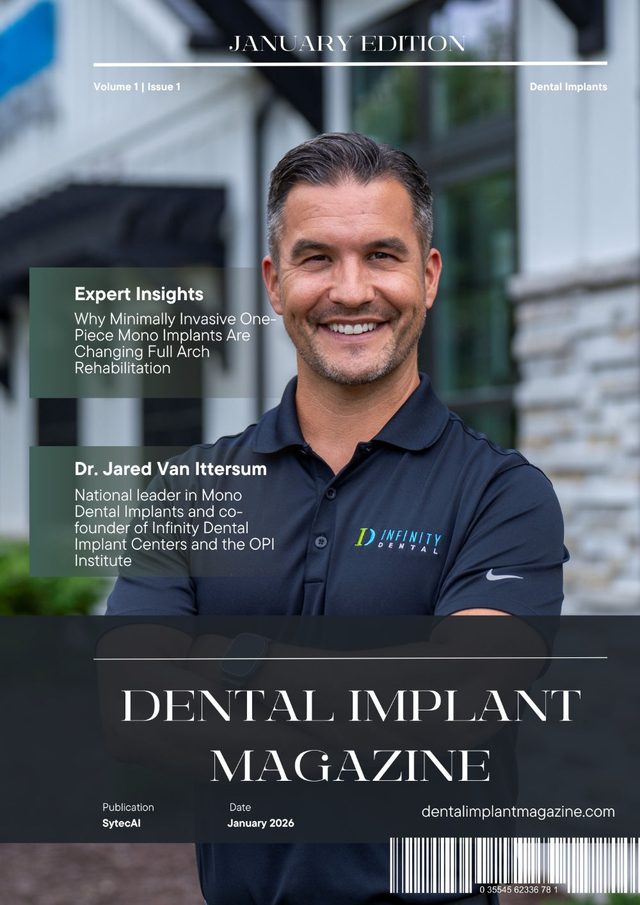
Thirty minutes on your cases, your training and your patients. No writing on your end.
A real editorial story, designed and published on dentalimplantmagazine.com.
It becomes a citation, a credential source and schema your entity points to. Every other component gets stronger.
Audit. Build. Lock in.
What AI says today about you, your competitors and your market. A diagnostic you can verify with the same ChatGPT query, not a sales deck.
Your DIM feature, schema, citation network, credential entity and consistency cleanup. Signals begin registering within 60–90 days, then compound.
Your position is contractually exclusive. No competing practice in your service area gets the same build.
One market. One practice. In the contract.
Two practices competing for the same specialty-and-city spot in the knowledge graph don't both get named. One does. So we build for one practice per market, and that's written into the agreement, not the ad copy.
Your market is either open or taken. Right now, most are open. We can't tell you how long that lasts.
One case. That's the threshold.
Less than most practices spend on a month of Google Ads, and ads vanish when billing stops. Stop paying for SEO and rankings erode. An entity in AI's knowledge graph doesn't disappear at the end of a billing cycle.
- Your Dental Implant Magazine feature
- Schema architecture, citation network, credential entity, cross-platform consistency
- A monthly entity position report: the same AI queries you can run yourself, in plain English
- Contractual market exclusivity
Fair questions, straight answers.
Isn't this just AEO or GEO optimization?
No. AEO and GEO vendors optimize content, and content is a channel. The Flywheel builds the entity that content points to: structured credentials, a citation network and one consistent identity. Different altitude, different result: list inclusion versus a named recommendation.
Can't my current SEO agency do this?
Ask them the vendor test: what entity have they built in AI’s knowledge graph, and how does it differ from optimized content? If the answer is blog posts and local SEO, they’re working a channel. Good at their job. Different job.
How do I know this works before committing?
Run the audit. It shows what AI says about you and your competitors today, and you can check it yourself with the same query. Then look up Dental Implant Magazine, the publication we built with the same system, and see what AI says about it.
What if AI changes how it works?
Tactics change; the need to know who’s who doesn’t. Every AI engine has to resolve people, credentials and places into entities it trusts. Structured, consistent, well-cited entity data is what that process reads, whichever engine is asking.
Why $3,500 a month?
Because it’s built, managed and compounded every month, including your magazine feature, and because one practice per market caps how many we take. One full-arch case covers more than seven months. One single-implant case covers the month.
Here's the part where I'm honest.
Close this page.
Try another agency. Wait for the AEO vendor to figure it out. Drive home tonight with the same question, and six months from now get the same answer. Or worse: someone else in your market figures this out first, and that position is taken.
Take 60 seconds.
Run the audit. See where your entity stands in your market, verified by you. Within 48 hours you'll have a full entity gap analysis. If the gap is what I think it is, we build the structure that closes it. Your name, in the answer.
Check your market →There's one entity position per market. When it's taken, it's taken. I can't tell you how long yours stays open, only that right now, it is.
Don't take my word for it. Ask ChatGPT about Dental Implant Magazine. Then ask it for the best implant dentist in your city. The difference between those two answers is entity structure.